API vs UI Answers: Which AI Visibility Data to Trust
By Abrar Navalur, Team Lead (AI)
In short
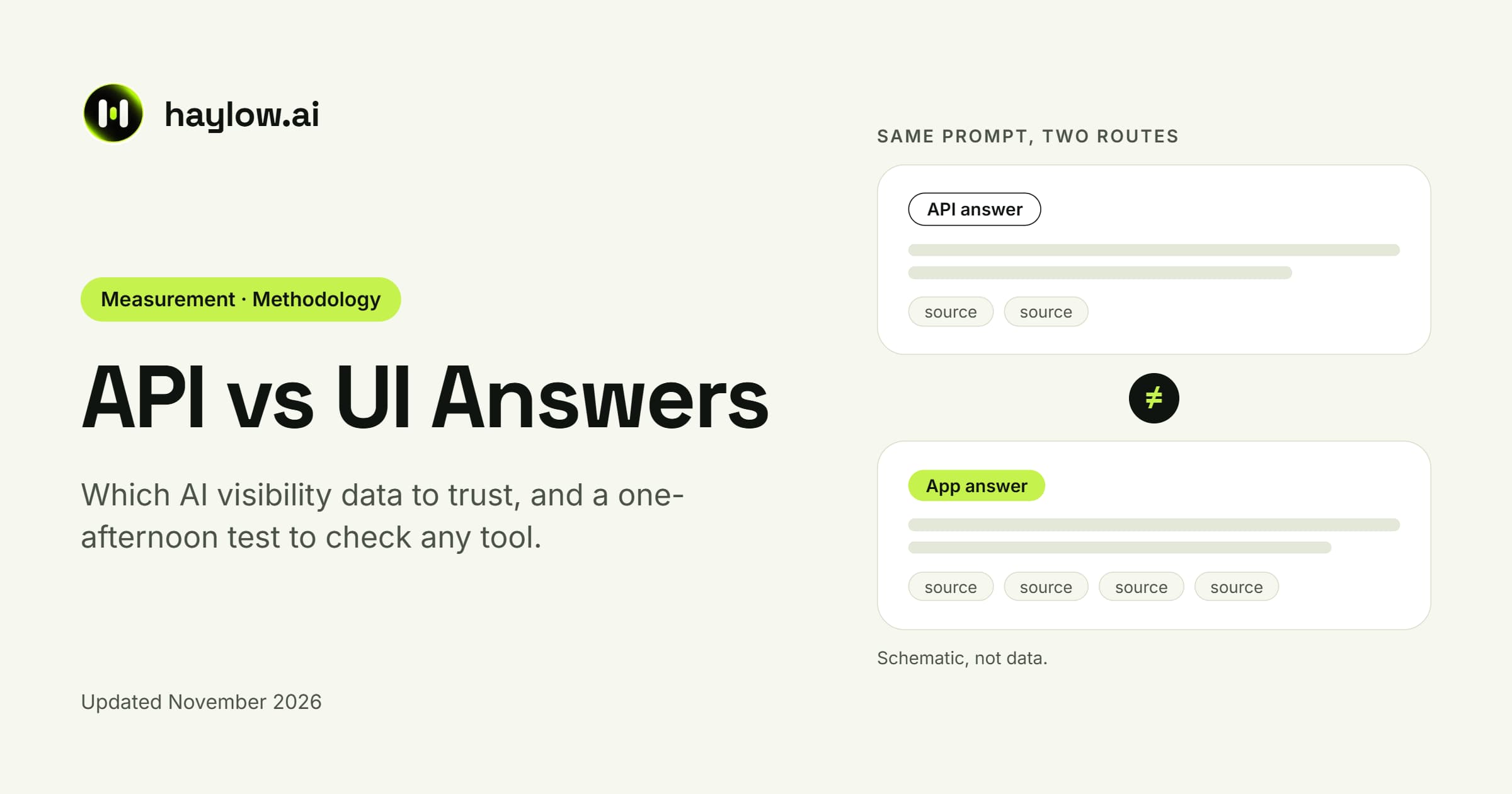
API-based AI visibility data and what real users see in ChatGPT, Gemini or Perplexity are not the same thing. Independent studies found clear gaps in sources, brands named and rankings. This guide explains why, when API data is still useful, and how to test any tool against the real app in one afternoon.
Why can API answers differ from what users see?
Because the API and the app are not the same product. A researcher who studied how AI visibility tools collect data points out that API collection often queries a different model build than the one consumers use, without the app's web search, personalization or interface-specific behavior. The app is a layer on top of the model, and that layer changes what gets retrieved, cited and named.
That does not make API data wrong. It makes it a different measurement, and you should know which one your tool is giving you. For background on how assistants pull in sources, see how AI assistants use search and citations.
What do the studies actually show?
Two published tests give a useful picture, with caveats:
Surfer SEO's study compared scraped app answers with API answers. It found that about a quarter of API answers carried no sources, while scraped answers always did and carried roughly twice as many. API answers also failed to name any brand in about 8 percent of cases.
Windsor.ai's test ran its own category prompts through both routes. In one ChatGPT round, a leading tool was named in 86 percent of API answers but 70 percent of app answers, and another in 84 percent against 59 percent. In one round, 7 percent of API answers named no tool at all, against 57 percent of app answers.
Treat these as strong signals, not final numbers. Both were run by vendors, on specific categories and fairly small prompt sets. The direction is consistent, though: API answers and app answers are not interchangeable.
When is API data still useful?
API-based tracking is a controlled sample, and a controlled sample is good at some jobs:
Trends over time. Every run uses the same method, so a change in mention rate is more likely to reflect a real shift than a change in collection.
Like-for-like comparison. You and your competitors are measured the same way, so share of voice is comparable.
Audit and cost control. The full answer can be stored and checked, and spend is predictable.
The weakness is absolute numbers. An API mention rate of 40 percent does not mean 40 percent of real users see you. Use it to see direction and relative position, not to quote an exact audience share.
When do you need interface-level data?
Use the real app, or a tool that captures it, when the exact experience matters: which sources a user actually sees, how an answer is formatted, what appears in Google's AI surfaces, or how answers differ by location and personalization. These are the cases where an API sample can miss what the user sees.
Interface-level collection has its own trade-offs. It is harder to run reliably, can be blocked, and may conflict with platform terms, so ask how a vendor does it and how it checks its own accuracy.
How can you test any tool in one afternoon?
Pick five prompts that matter commercially, written the way your buyers ask them, in your market's language. For Indian brands, include Hinglish (see our prompt library for India).
Run each prompt three times in the real app, each time in a fresh chat. Record the brands named, their order and the sources cited.
Run the same five prompts in the tool, three times each.
Compare brands named, order, sources and the spread between runs.
Decide what the tool is good for. If the relative ranking against competitors agrees but absolute rates differ, use it for trends. If the brand sets differ widely, treat it as a different measurement and do not mix the two.
Repeat the test every quarter on your top prompts, because assistants change. Our guide to choosing prompts to track helps you pick the five.
What should you ask an AI visibility vendor?
How do you collect answers: API or the real interface?
Is web search on, and how is location set?
Do you store the full raw answer, and can I read it?
How many times do you run each prompt, and how do you report variation?
Which model version answered?
How do you check your data against the real app?
If a vendor cannot answer these, treat its scores as estimates. Our nine criteria for comparing AI visibility tools puts these questions in context.
How does haylow.ai approach it?
haylow.ai calls the official APIs of ChatGPT, Gemini, Claude, Perplexity and Grok, stores the exact prompt and full response behind every metric, and links each score back to its answer. It describes results as a fixed-prompt sample, not a live mirror of what one person sees in a consumer app, and it does not track Google AI Overviews or AI Mode.
That makes it well suited to trends and like-for-like comparison, and it means you should run the test above, especially for prompts where the exact sources matter. You can start a free seven-day trial to run it on your own prompts, or read how AI visibility tracking works.
Sources and further reading
Studies and research referenced: Surfer SEO on scraped answers vs API results, Windsor.ai on AI visibility tracking accuracy and Metehan Yesilyurt on how AI visibility tools collect data. Figures are paraphrased from those sources and may change as the studies are updated.
Key takeaways
- API answers and consumer-app answers can differ in sources, brands named and order, so API data is a controlled sample, not a mirror of the app.
- Independent studies found gaps, but they are small, vendor-run and category-specific, so test your own prompts.
- API data suits trends and like-for-like competitor comparison. Interface-level data suits checking the exact user experience.
- Run a one-afternoon test: five prompts, three runs each, in the real app and in the tool.
- Ask every vendor how answers are collected, whether web search is on and whether the raw answer is stored.
Frequently asked questions
Do AI visibility tools that use APIs show what users really see?
Not exactly. Independent studies found that API answers and app answers differ in sources, brands named and order, so API data is a controlled sample, not a mirror of the consumer app.
Is UI scraping more accurate than API data?
It captures what the interface shows, including sources, but it is harder to run reliably, can be blocked and may conflict with platform terms. Ask any vendor how it collects and verifies its data.
When is API-based tracking good enough?
For trends over time and for comparing your brand with competitors under identical conditions, because every run uses the same method.
How do I test whether a tool matches the real app?
Run five prompts that matter to you, in your market's language, three times each in the real app and in the tool. Then compare brands named, their order and the sources cited.
Why do answers change between runs?
Assistants are not deterministic, so the same prompt can return different brands in a different order. One independent test found that two API calls made hours apart moved a ranking by about 1.7 places on average, so report rates across repeated runs.
What should I ask an AI visibility vendor about data collection?
Ask how answers are collected (API or interface), whether web search is on, whether the raw answer is stored, how many runs each prompt gets, which model version answered and how location is set.
How does haylow.ai collect its data?
haylow.ai calls the official APIs of ChatGPT, Gemini, Claude, Perplexity and Grok, stores the full prompt and response behind every metric, and presents results as a fixed-prompt sample, not a live mirror of consumer apps.
See what AI says about your brand
Add one domain and get your first visibility report across five assistants. Free to start, no card required.