How to Price GEO Services: A Guide for Indian Agencies
By Abrar Navalur, Team Lead (AI)
In short
Price GEO services from your own costs, not from tool prices. This guide shows four pricing models, a cost-plus method with a worked rupee example, three package tiers and the mistakes that sink margins, so Indian agencies can quote AI visibility work with confidence.
What are you actually selling when you sell GEO?
GEO is not one service. It is four pieces of work that agencies often bundle without pricing them separately:
Baseline and prompt research: the questions buyers ask, tested across assistants, with a measured starting point.
Monitoring and reporting: a fixed prompt set, run on a rhythm, reported as trends with sources.
Content and technical fixes: restructuring pages so answers are easy to extract and quote.
Authority and citations: earning a place on the third-party sources assistants already cite.
Price each piece on its own first. Then decide how to package them. Our guide to running an AI visibility audit in one afternoon shows what the baseline involves.
What do GEO services cost in the market?
US agency pages give useful reference points, though not Indian quotes. One packaging guide from Demand Local describes four models: a one-time audit at roughly $1,500 to $5,000, a monthly retainer at $3,000 to $10,000 or more, a hybrid add-on to an SEO retainer at a 20 to 30 percent uplift, and a white-label reseller arrangement with a 40 to 60 percent markup. A broader roundup from Nutshell puts professional GEO agency services anywhere from about $1,500 to $50,000 a month, and software from $10 to over $1,000 a month.
Treat these as ranges to sanity-check against, not as prices to copy. They are in US dollars, they come from US agencies, and scope varies widely between them.
Which pricing model should you choose?
Fixed-fee audit. The easiest way in. A client can buy a baseline without committing to a retainer, and audit clients often convert to monthly work.
Monthly retainer. The default for most agencies, because AI visibility needs recurring measurement and fixes.
Add-on to an SEO retainer. The simplest first sale for clients you already serve, with separate reporting for AI-driven visibility.
White-label arrangement. Useful if you resell to other agencies, but you still carry delivery quality, so price the margin carefully.
If you are starting out, lead with the audit and the add-on, and build the full retainer from what the audit uncovers.
How do you calculate a price that protects your margin?
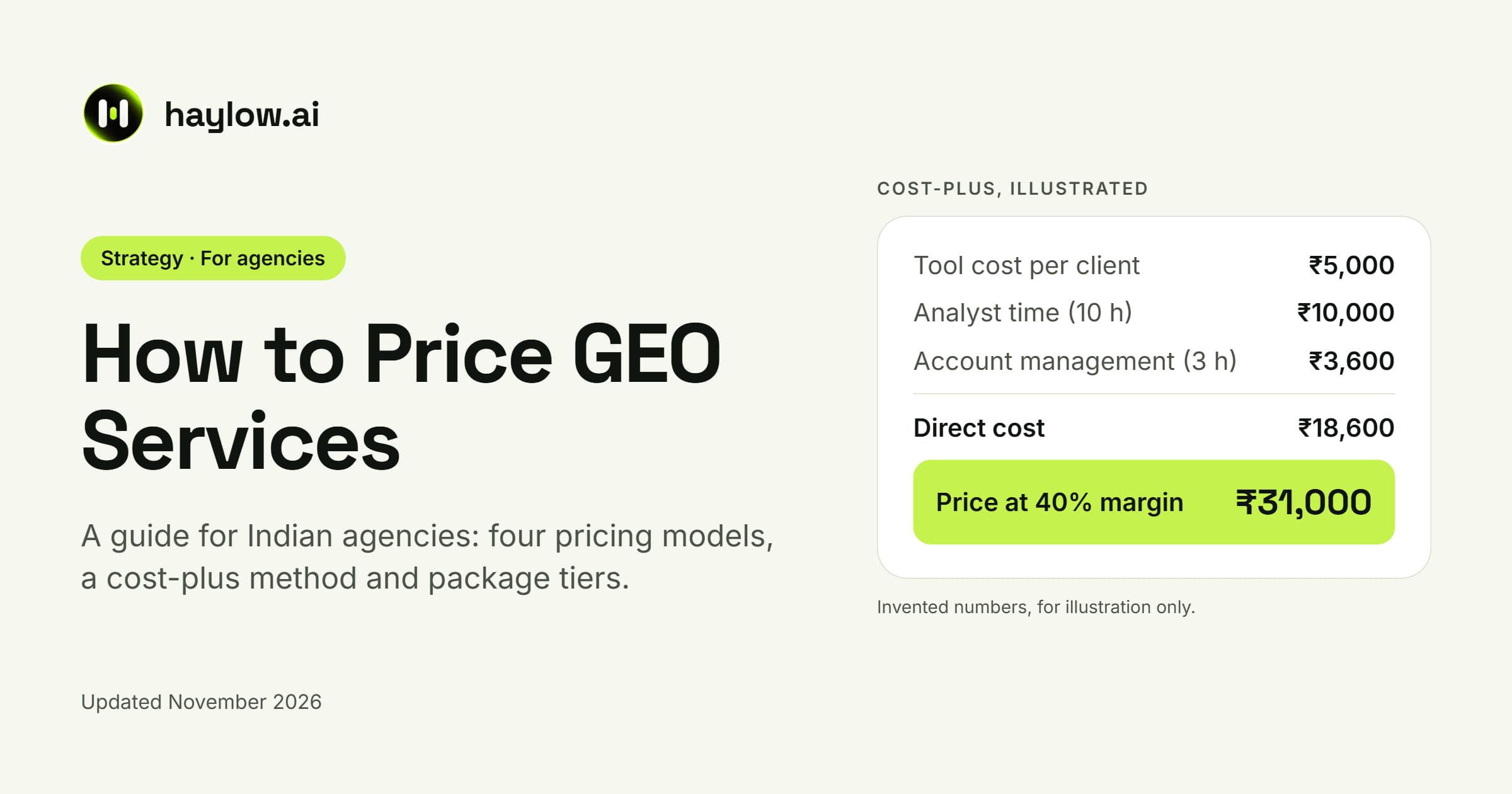
Use cost-plus pricing: add up your direct costs for one client, then divide by one minus your target margin. The tool is only one line in that sum. Here is an illustration with invented numbers, so replace each one with your own:
Tool cost per client: ₹5,000
Analyst time: 10 hours at ₹1,000 = ₹10,000
Account management: 3 hours at ₹1,200 = ₹3,600
Direct cost: ₹18,600
Price at a 40 percent margin: ₹18,600 ÷ 0.6 = ₹31,000 a month
These figures are an illustration, not a market benchmark. The 40 percent target is also only an example, so set yours. Then check the result against what the client would pay for comparable work, such as a content or PR retainer, because cost-plus gives you a floor, not a ceiling.
What should each package include?
Audit (one-time): a baseline of 30 to 50 prompts across ChatGPT, Gemini, Claude, Perplexity and Grok, the sources cited in the client's category, and a ranked fix list.
Monitor and report (monthly): a fixed prompt set per client, weekly runs, and a monthly report with the trend, sources and next actions.
Grow (monthly): everything above plus content restructuring, technical fixes and citation outreach.
Write the scope into the proposal in plain terms: how many prompts, which assistants, how often you run them and what the client receives each month.
What should the client report show?
Show a fixed prompt set, mention rate by assistant, the trend against last month, the sources cited and the actions you will take next. Keep the full answers on file so you can show the sentence that named, or missed, the client's brand. Our guide to reporting AI visibility to clients covers the format step by step, and share of voice in AI answers explains how to compare a client with competitors in a way that survives scrutiny.
Which mistakes sink GEO pricing?
Pricing like software. Tool prices run from a few dollars to about a thousand a month. Your expertise, analysis and fixes are the service.
Promising citations or rankings. No provider can guarantee a citation, so promise measurement, a plan and fixes.
Skipping the baseline. Without a measured starting point you cannot show progress later.
Leaving scope open. Fix the prompt count, the assistants and the reporting rhythm in writing.
Hiding tool cost. If you cannot see what each client costs to track, you cannot protect your margin.
How does haylow.ai help agencies price and deliver GEO?
haylow.ai gives each client a workspace with owner, admin and member roles, branded PDF and CSV reports, and permission-controlled share links. It shows real API spend per workspace, so the tool line in your cost-plus sum is a number you can read, not a guess. Every report traces back to the full answer behind it. The Agency plan supports up to 25 brands.
To see how it fits your client roster, talk to us about the Agency plan, compare plans on the pricing page, or start a free seven-day trial. If you are still choosing between tool types, read platform vs tracker vs checker and our nine criteria for comparing tools. For Indian clients, AI search visibility for Indian brands covers local questions and languages.
Sources
Dollar ranges come from Demand Local and Nutshell; the note on guarantees comes from 5W. The rupee example is our own illustration with invented numbers, not a market benchmark.
Key takeaways
- Price GEO from your direct costs plus a margin target, not by matching what AI visibility tools cost.
- Four models work: a fixed-fee audit, a monthly retainer, an add-on to an SEO retainer, or a white-label arrangement.
- US pages put audits at roughly $1,500 to $5,000 and retainers from about $3,000 a month. Use them as reference points, not as Indian quotes.
- Sell measurement and fixes, never guaranteed citations or rankings.
- Show every client the trend, the sources and the next actions, backed by stored answers.
Frequently asked questions
How much should an agency charge for GEO services?
There is no single price. US agency pages show audits from about $1,500 to $5,000 and retainers from roughly $3,000 to $10,000 or more a month, but Indian agencies should price from their own costs and margin target, and use those figures only as reference points.
What pricing model works best for GEO?
A monthly retainer suits most agencies because AI visibility needs recurring measurement and fixes. A fixed-fee audit is a good way in, and an add-on to an existing SEO retainer is often the easiest first sale.
Can I guarantee that a client will appear in ChatGPT or Gemini?
No. Nobody controls what assistants say, so promise measurement, a plan and fixes. Report mention rate and sources, and avoid guarantees.
Should the cost of the tracking tool be part of the retainer?
Yes. Work out the tool cost per client, add it to your direct costs, then add analyst time and a margin. haylow.ai shows real API spend per workspace, which makes this step easy.
What should a monthly GEO report include?
A fixed prompt set, mention rate by assistant, the trend against last month, the sources cited and the next actions. Our guide on reporting AI visibility to clients walks through the format.
How many prompts should I track per client?
Start with 30 to 50 prompts across the intents that matter to the client's buyers, then keep the set stable so trends stay comparable.
Can haylow.ai handle several client brands?
Yes. haylow.ai gives each client its own workspace with roles, branded PDF and CSV reports and permission-controlled share links, and the Agency plan supports up to 25 brands.
See what AI says about your brand
Add one domain and get your first visibility report across five assistants. Free to start, no card required.